Polyomino Tiler
Created by Kentaro Suzuki
Published on: 2024-02-01
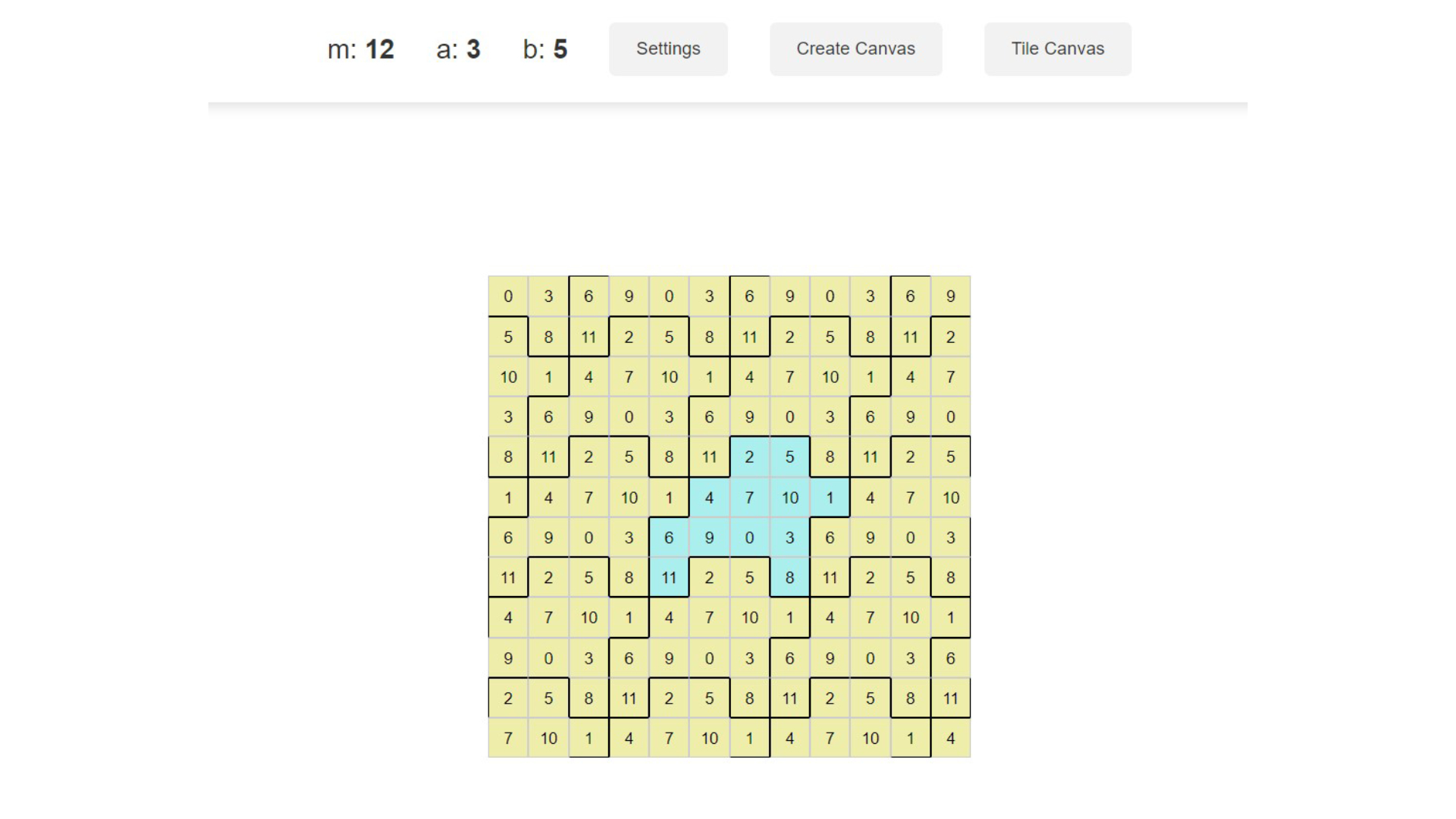
Polyomino Tiler is a cutting-edge web application designed to spark creativity and innovation across various domains, including graphic design, illustration, and education. This unique platform enables users to generate intricate tiling patterns using custom-made polyominoes, offering a bridge between mathematics and art.
How to Use Polyomino Tiler:
- Creating Your Canvas: The application features a grid, termed as the 'canvas,' composed of square cells arranged in an \(m \times m\) format. Each cell is assigned a 'cell number,' calculated based on user-defined integers \(m\), \(a\), and \(b\), along with the cell's coordinates. It's crucial that all integers from 0 to \(m-1\) appear across the canvas. If not, users must adjust the values of \(m\), \(a\), and \(b\).
- Setting m, a, and b: Through the 'Settings' menu, users can define the integers \(m\), \(a\), and \(b\). \(m\) ranges from 2 to 100, and all values must be integers. Confirm your selection by clicking 'OK'.
- Constructing Polyominoes: Users select \(m\) cells on the canvas by clicking, paying attention to the displayed cell numbers. Selected cells must cover all integers from 0 to \(m-1\) to form a valid polyomino.
- Generating Tiling Patterns: Once a valid polyomino is constructed, the 'Tile Canvas' button becomes active. Pressing this button generates the tiling pattern on the canvas. This pattern, which forms a square, can be replicated across a plane to demonstrate how the polyomino tiles the surface through translations only.
- Resetting the Canvas: The 'Create Canvas' button allows users to clear the existing canvas and generate a new one for further exploration.
Mathematical Foundation:
Each cell on the canvas is assigned coordinates, with the top-left cell marked as the origin \((0,0)\). A cell located \(x\) cells to the right and \(y\) cells down from the origin has coordinates \((x,y)\). The cell number \(r\) for any given cell is calculated as \(r = (ax + by) \% m\). For all integers from 0 to \(m-1\) to appear as cell numbers, it is necessary and sufficient that the greatest common divisor (GCD) of \(a\) and \(b\), denoted as \(d\), and \(m\) are coprime(i.e., \(d\) and \(m\) share no common divisors other than \(1\)).
Embrace the challenge and creativity of polyomino tiling with Polyomino Tiler—where mathematical precision meets artistic freedom.
Note: Development of the "Polyomino Tiler" was aided by AI technology, including ChatGPT, primarily for coding support. This collaboration highlights the integration of human creativity and AI efficiency in creating innovative tools.
Launch App
